September 7, 2026

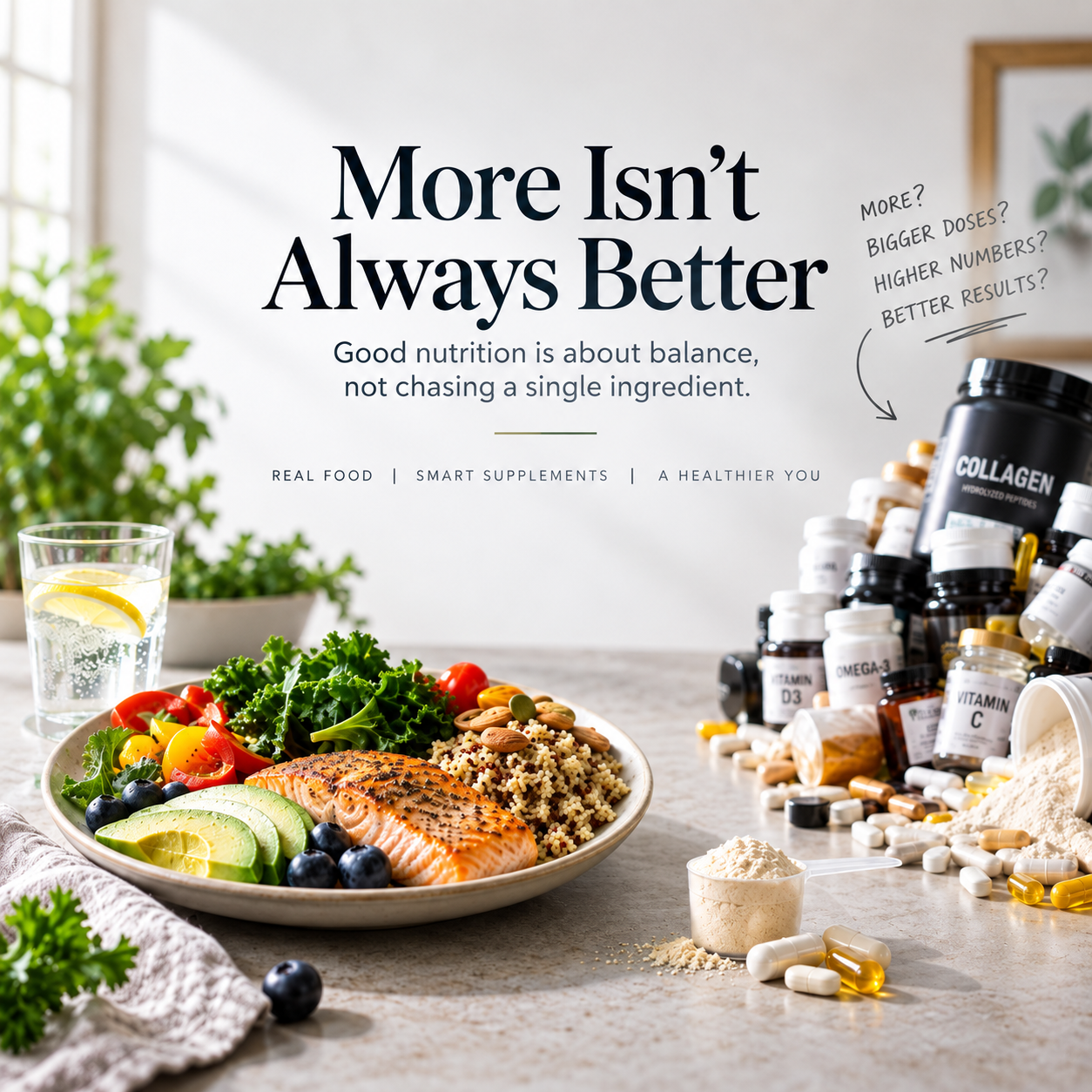
When we learn that a particular nutrient or biological compound is important, it is easy to make a very understandable assumption:
If some is good, more must be better.
That way of thinking shows up everywhere in the supplement world. More protein. More collagen. More vitamin C. More magnesium. A higher percentage of the Daily Value. A larger number on the front of the package.
But nutrition is rarely that simple.
The human body does not function one nutrient at a time. It is an enormously complex biological system in which nutrients, amino acids, enzymes, substrates, cofactors, signaling molecules, and thousands of biochemical reactions are continually interacting.
Good nutrition has to be viewed in much the same way: not as a search for one perfect ingredient, but as the process of providing the body with the variety of things it needs, in appropriate amounts, working together.
And that leads to an important principle that can easily get lost in conversations about supplements:
More is not automatically better. The goal is to give the body what it actually needs.
Dietary supplements can certainly have a useful place in nutrition. They may help address nutritional gaps, support particular goals, or provide nutrients that may be difficult for someone to obtain in sufficient amounts from food alone.
But the word supplement is important.
A supplement is intended to add to a nutritional foundation—not replace one.
The Dietary Guidelines for Americans emphasize a dietary pattern based primarily on nutrient-dense foods, including vegetables, fruits, protein foods, healthy fats, whole grains, and other nutrient-rich choices [1]. The National Institutes of Health similarly notes that dietary supplements may help people obtain adequate amounts of essential nutrients but cannot replace the variety of foods that make up a healthy eating pattern [2].
There is a biological reason for that.
Foods do not simply provide isolated vitamins or minerals. A varied diet supplies protein and amino acids, carbohydrates, fats, fiber, vitamins, minerals, water, and a tremendous assortment of other naturally occurring compounds.
When the overall dietary pattern is poor, adding one nutrient—or even several nutrients—does not suddenly make that pattern nutritionally complete.
Supplements can complement good nutrition. They cannot reproduce everything that comes from consistently eating well.
This does not mean a diet has to be perfect.
An occasional indulgence does not undo an otherwise healthy eating pattern, just as one salad does not transform a consistently poor one. What matters most is the pattern that develops over time.
And the same principle applies when exercise enters the picture.
Exercise is one of the most valuable things we can do for our health. Regular physical activity supports cardiovascular fitness, musculoskeletal health, metabolic function, and numerous other aspects of well-being.
But exercise and nutrition are not interchangeable.
A morning walk, a workout at the gym, or a set of dumbbell curls does not provide the protein, vitamins, minerals, fiber, essential fatty acids, and other nutrients that may be missing from someone's diet.
This is where a familiar way of thinking can become misleading, like this example:
“I exercised today, so I earned these chili cheese fries.”
There is nothing inherently wrong with **occasionally** enjoying chili cheese fries—or pizza, ice cream, dessert, or any other food eaten primarily because we enjoy it.
The issue is the overall pattern, and repeating this line of thought day after day. By continuing this same pattern, it becomes highly problematic.
A nutrient-dense diet can include **occasional** indulgences. What becomes problematic is treating exercise as though it can continually compensate for a dietary pattern that does not adequately provide what the body needs.
Research examining diet and physical activity together supports the importance of both. In a prospective analysis of more than 346,000 UK Biobank participants, lower mortality risk was consistently associated with combinations of higher physical activity and better diet quality [3].
The takeaway should not be that diet matters and exercise does not, or vice versa.
Both matter.
They support health in different and complementary ways.
A similar pattern often appears in the way people think about supplements.
A nutrient or compound gets attention. We learn that it has an important biological role. Before long, it can begin to sound as though that one thing might be what everyone has been missing, whether it be protein, collagen, magnesium, vitamin C, zinc, or whatever the ingredient may be, the conversation can gradually shift from “this nutrient is important” to “therefore, even more of it must be better.”
Those are not the same statement.
If someone is genuinely deficient in a nutrient, correcting that deficiency can be very important. In some circumstances, targeted supplementation may be exactly what is needed.
However, correcting an inadequacy is very different from assuming that three, five, or ten times as much will produce three, five, or ten times the benefit.
Human physiology generally does not operate according to that kind of simple arithmetic.
Nutrition science has developed formal concepts that help describe this distinction.
The Dietary Reference Intake framework includes recommended intake values intended to help meet nutritional needs, as well as Tolerable Upper Intake Levels for many nutrients. An upper intake level is not a target to strive toward. It is intended to identify an intake above which the risk of adverse effects may increase [4].
In other words, the highest number is not automatically the best number.
This is worth remembering when looking at supplement labels.
A product providing 500%, 1,000%, or even several thousand percent of a Daily Value can look impressive. In some situations, higher amounts may have a legitimate nutritional or clinical rationale. In others, additional intake may provide little additional benefit, and excessive amounts of some nutrients can create their own problems.
Context matters.
The amount already supplied by the diet matters.
The nutrient itself matters.
Individual needs matter.
And the purpose for taking the supplement matters.
A Supplement Facts panel is not a scoreboard. Bigger numbers do not automatically mean better nutrition.
Research using U.S. dietary data illustrates both sides of supplementation nicely. Supplements can help reduce the prevalence of inadequate nutrient intake among people whose food intake falls short [5,6]. At the same time, supplement use can increase the proportion of people whose total intake exceeds established upper levels for certain nutrients [5,6].
That does not make supplements good or bad.
It means they should be used thoughtfully.
There is also an important broader nutritional point.
If someone is genuinely deficient in one nutrient—particularly when the deficiency arises in the context of an overall poor dietary pattern—there is a reasonable possibility that the one nutrient identified is not the whole story.
Nutrient inadequacies can occur together, and greater dietary diversity generally improves the likelihood that a diet will provide a broader spectrum of micronutrients [7].
That does not mean every deficiency implies several others.
A person may have an isolated deficiency because of restricted food choices, altered absorption, increased physiological requirements, medication effects, blood loss, or many other specific circumstances.
But when the underlying problem is a consistently inadequate diet, it makes sense to look beyond a single molecule.
Poor nutrition usually is not simply the absence of one magical ingredient.
The body requires a much broader nutritional foundation.
It is a system working continuously to keep cells, tissues, organs, and physiological processes functioning.
That requires much more than one biomolecule.
Consider protein metabolism alone.
Proteins are built from amino acids. Enzymatic reactions are necessary to synthesize, modify, and break down biological molecules. Energy is required. Vitamins and minerals participate in many biochemical pathways, often as cofactors or components of enzyme systems. Hormones and other signaling molecules influence metabolism and gene expression.
No single nutrient performs all of those jobs.
A nutrient can be critically important without being independently sufficient.
Collagen provides a useful example.
Collagen is not one isolated molecule performing one isolated task. It represents a large family of structural proteins that are major components of the extracellular matrix and contribute to the structure and mechanical properties of many tissues [8].
Collagen proteins also have a distinctive structure and amino-acid composition. Glycine appears at every third position within the characteristic collagen triple helix, while proline and hydroxyproline are important contributors to collagen structure and stability [9].
And collagen synthesis itself depends on more than simply having collagen—or even its constituent amino acids—available.
Vitamin C, for example, serves as an essential cofactor for enzymes involved in hydroxylation reactions required during normal collagen biosynthesis [10].
This is a useful reminder of the larger principle:
Biological processes depend on systems of interacting components.
Recognizing the importance of one component should not cause us to forget everything else.
Collagen synthesis itself depends on more than simply having collagen. Biology works through systems—not single ingredients.
A more useful approach to supplementation begins with better questions.
Instead of simply asking:
“Which product gives me the most?”
it may be more helpful to ask:
Why am I supplementing this in the first place?
What nutritional or physiological goal am I trying to support?
How much am I already getting from food?
Is there evidence supporting the amount I am considering?
Are there other nutrients or biological factors involved in the same process?
Am I using a supplement to complement a reasonable diet—or hoping it will compensate for one that needs improvement?
Those questions move the conversation away from chasing numbers and toward using supplements with purpose.
Sometimes intelligent supplementation means addressing a documented deficiency with guidance from an appropriate healthcare professional.
Sometimes it means filling a practical nutritional gap.
Sometimes it means supporting a particular nutritional goal.
And sometimes the conclusion may simply be that the diet is already providing enough.
The goal is not to avoid supplements.
The goal is to supplement intelligently.
This philosophy also influences how we approached CollaGenesis™ and CollaGenesis-V™.
Both formulas are intentionally highly comprehensive.
That is a deliberate part of their design.
Rather than building the formulas around the assumption that one very large dose of one ingredient is the answer, CollaGenesis and CollaGenesis-V were developed around a broader nutritional approach, with a particular emphasis on collagen support.
That includes protein, amino acids, vitamins and minerals, and other supportive compounds incorporated into a more complete nutritional formulation.
The idea is not that every person needs enormous amounts of every ingredient.
Quite the opposite.
The intent is to provide a range of nutritional components that can complement a healthy diet while supporting a particular nutritional goal—in this case, collagen and connective-tissue support.
Oral collagen research itself provides an interesting example of why the conversation should not be reduced to one number.
A 2023 systematic review and meta-analysis of 26 randomized controlled trials reported improvements in measures of skin hydration and elasticity with hydrolyzed collagen supplementation, while also noting variability among studies and the need for additional high-quality research [11].
An updated 2026 systematic review and meta-analysis similarly reported improvements in skin hydration and elasticity. Interestingly, its analyses suggested that some observed effects appeared to be more dependent on duration of supplementation than simply on increasing dose [12].
That does not mean dose is irrelevant.
It means dose is one part of a much larger picture.
And that is the point.
Even a highly comprehensive supplement is still a supplement.
CollaGenesis does not replace vegetables.
CollaGenesis-V does not replace fruit, whole foods, dietary variety, or an otherwise balanced eating pattern.
Neither product makes exercise unnecessary.
And neither should be viewed as permission to ignore food quality.
Can they still provide useful nutrients and collagen support when someone's diet is not ideal?
Certainly. Almost nobody eats a perfect diet every day, and one of the practical roles of supplementation is to add nutritional support where appropriate.
But there is an important difference between adding useful nutrition and fixing a chronically poor dietary pattern.
A supplement cannot recreate everything that comes from consistently eating a varied, nutrient-dense diet.
Nor should we expect it to.
Perhaps one of the most useful changes we can make in the way we think about supplements is to stop treating the label like a competition.
The largest dose is not automatically the best formulation.
The highest Daily Value is not automatically the most useful choice.
And the nutrient receiving the most attention at the moment is not necessarily the one thing standing between someone and optimal nutrition.
A better question is whether the formulation makes nutritional sense.
Do the ingredients have a logical purpose?
Are the amounts appropriate for that purpose?
Do the components complement one another?
Does the supplement fit into the person's overall diet?
And does it support a genuine nutritional goal rather than simply offering the biggest number on the shelf?
Good nutrition is not built around one ingredient.
Neither is the human body.
Eat real food. Eat well. Give your body what it actually needs. And if you choose to supplement, supplement intelligently.
If you believe you may have a true nutrient deficiency—particularly one producing symptoms or identified through laboratory testing—it may be appropriate to discuss it with a qualified healthcare professional rather than simply increasing supplement doses on your own.
Individual nutritional needs vary, and a deficiency may sometimes have an underlying dietary, physiological, or medical cause that deserves appropriate evaluation.
This article is intended for general educational purposes and is not a substitute for individualized medical or nutritional advice.